Product presence
See which stores list your tracked products and how that presence changes across the markets REDD covers.
REDD brings store-level menu observations into one view, so Michigan brands can see product presence, coverage gaps, listed prices, and restock history across the markets they care about.
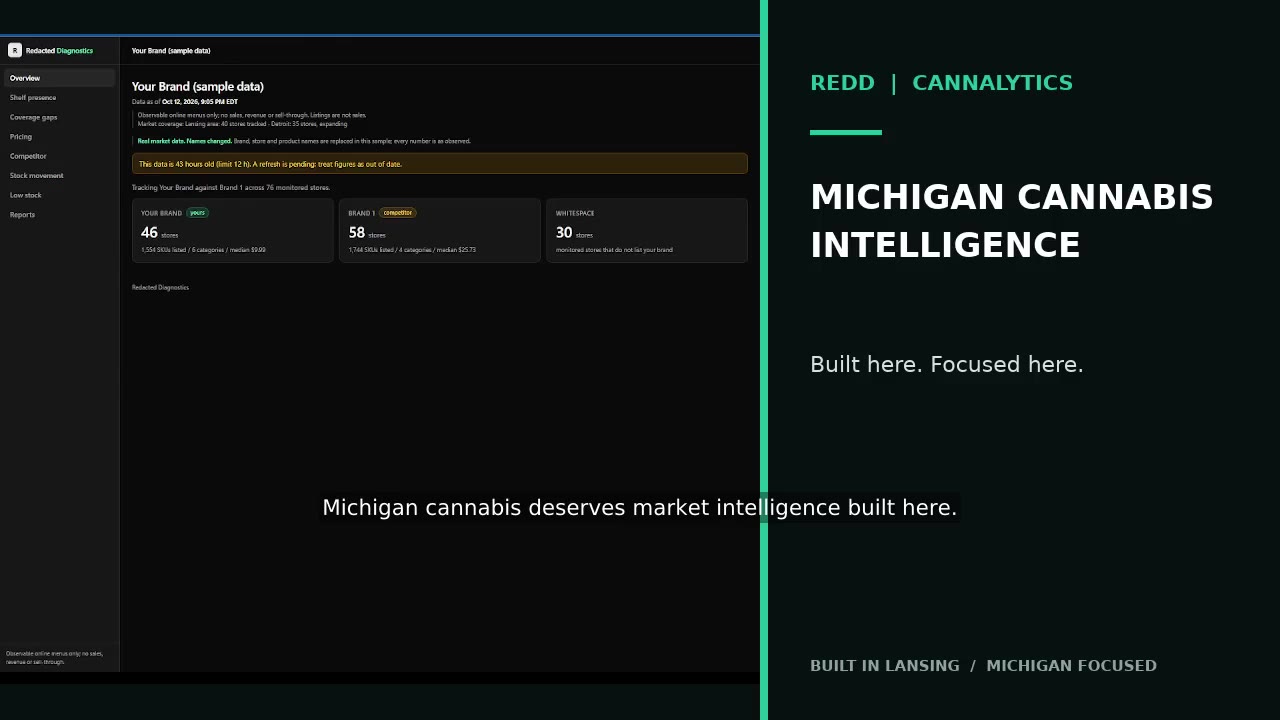 See it in 35 secondsReal Michigan menu data, names changed. Then open the sample portal yourself.
Active zones and expansion progress
Data last updated October 15, 2026License data as of August 20, 2026
REDD covers 76 of 868 active retail locations (8.8%). Counts are updated by hand, not live. Locations are distinct street addresses with an active adult-use retailer, provisioning center, or microbusiness license. Of 76 scheduled stores, 75 currently produce data; one Lansing location has no online menu.
A short walkthrough of REDD’s Michigan market coverage and the store-level signals built for cannabis brands.
Turn repeated menu observations into a practical picture of where your products appear, where they’re missing, and how availability changes over time.
See which stores list your tracked products and how that presence changes across the markets REDD covers.
Spot stores and zones where your products aren’t appearing, then decide where to focus follow-up.
Review listed prices across observed menus to understand how your products are positioned in market.
Follow observed in-stock and out-of-stock changes over time, with event history in one place.
Figures from the masked sample as of October 15, 2026. Brand and store names are replaced. A listing is not a sale: nothing here shows sales, revenue or sell-through.
The alert email is a pilot feature; the card shows the layout of one digest built from a real out-of-stock observation.
REDD is built to help your team spend less time guessing about store-level availability and more time deciding where a conversation, visit, or follow-up could matter.
Use product presence and coverage gaps to prioritize account conversations.
Use restock history and scan observations to follow market movement.
Start with email alerts when scans detect a tracked product out of stock.
REDD is based in Lansing and focused on our home state. Expansion is planned zone by zone as coverage and data quality are validated.
Current coverage is focused on Lansing and Detroit. Explore the interactive map above for zone status.
Review observations and data quality as coverage develops, so the product earns trust market by market.
Bring additional markets online as each zone meets the standard. Michigan is the focus.
My roots are here, and so is this company. I’m the owner and developer behind REDD. I want Michigan businesses to have a market intelligence tool built with care for the state, the people working in it, and the quality of the data they rely on.
Ralph · Founder and developer · Lansing, MichiganChoose the brands and products you want to track, review what the data helps your team see, and evaluate the usefulness together. We’ll discuss pricing and fit directly.
REDD organizes store-level menu observations, including product presence, coverage gaps, listed prices, and observed restock history.
Current active focus is Lansing and Detroit. Other Michigan markets are part of the expansion plan as zones are validated.
The pilot is designed to send an email within hours after scans detect a tracked product has gone out of stock. The observation reflects listed menu data and should be confirmed with the retailer.
Open the sample portal or book a pilot review, identify the brands and products you want to evaluate, then review pilot scope and pricing together.